Vial sizes: a size chart and how to pick a vial case
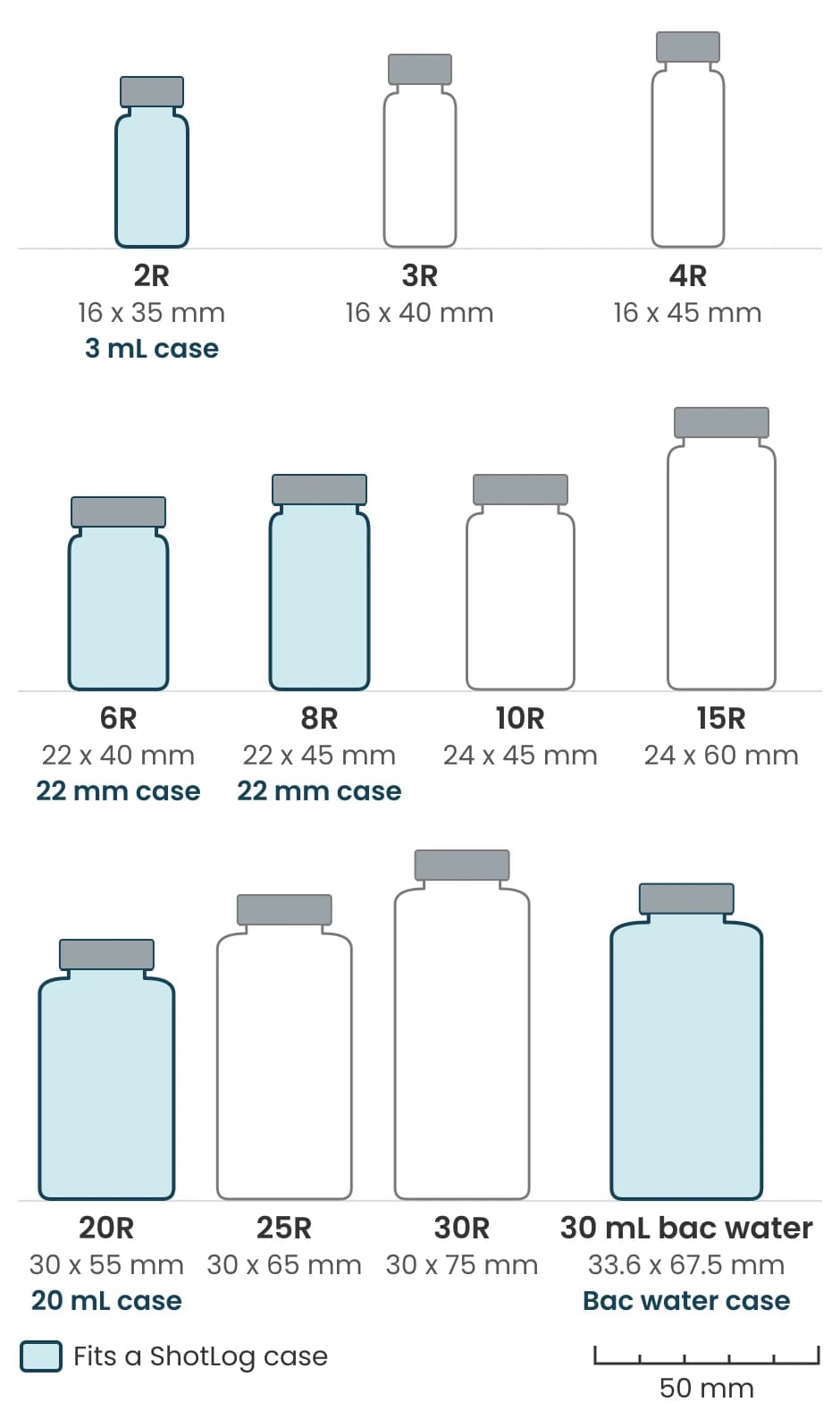
Peptide vials, bacteriostatic water vials and other glass vials come in a handful of standard vial sizes. Pick a vial case by your vial's size in millimeters, not by the mL on the label. Two vials sold as "10 mL" can be 21 mm or 24 mm wide, and a case made for one will not take the other. Measure the glass across and from bottom to top, then match it to a case below. If nothing we sell fits, we can design and 3D print a case for your vial.
Trade size vs ISO size: why the mL number is not enough
Vials get named two ways, and the two get used as if they mean the same thing.
- Trade size: the mL name a seller puts on the box, such as 3 mL, 5 mL or 10 mL. Each maker picks its own shape for that name.
- ISO size: a code from ISO 8362-1, the standard for glass vials made from tubing. Codes look like 2R, 6R or 10R. Each code fixes the vial's width and height.
The number in an ISO code is a format, not a volume. A 2R vial holds about 4 mL filled to the brim, and it is often sold as a 3 mL vial. A 10R vial is 24 mm wide, while many vials sold as 10 mL in the US are about 21 mm wide and taller.
This is how people end up with a case that does not fit. They order a case for "10 mL vials", and their 10 mL vial is a different shape.
Vial size chart: standard vial dimensions in mm
| ISO size | Width x height | Brimful |
|---|---|---|
| 2R | 16 x 35 mm | 4 mL |
| 3R | 16 x 40 mm | 5 mL |
| 4R | 16 x 45 mm | 6 mL |
| 6R | 22 x 40 mm | 10 mL |
| 8R | 22 x 45 mm | 11.5 mL |
| 10R | 24 x 45 mm | 13.5 mL |
| 15R | 24 x 60 mm | 19 mL |
| 20R | 30 x 55 mm | 26 mL |
| 25R | 30 x 65 mm | 32.5 mL |
| 30R | 30 x 75 mm | 37.5 mL |
Most people know their vial by the mL on the label, and those vials often follow no ISO size at all. These are typical sizes from US vial makers' spec sheets.
| Sold as | Typical width x height |
|---|---|
| 2 mL | 15 x 32 mm |
| 3 mL | 16 to 17 x 35 to 38 mm |
| 5 mL | 20 x 38 to 40 mm |
| 10 mL | 21 x 51 mm, some 24 mm wide |
| 20 mL | 30 x 55 to 58 mm |
| 30 mL bacteriostatic water | 33.6 x 67.5 mm |
Width is across the glass body. Height is the glass from bottom to top. A flip-off cap adds a few millimeters, so measure with the cap on if it will stay on. A given maker's vial can be a fraction of a millimeter off these numbers.
How to measure a vial
What you need: a ruler or calipers marked in millimeters.
- Measure across the widest part of the glass body.
- Measure from the bottom of the vial to the top of the cap, with the flip-off cap on if it stays on.
- Compare both numbers with the case limits below.
Width matters most. A vial even 1 mm too wide will not go into a pocket.
Each vial case product page has a size picture that prints at life size at 100%. Lay your vial on the outlines to check.
Which vial case or vial holder fits
Each ShotLog vial case lists the largest vial its pockets take. Check your vial against those numbers, not against the mL name.
- Vial Case for 3 mL Vials: holds 1, 4, 6 or 12 vials about 16.5 mm wide, with up to 37.5 mm of glass and the flip-off cap on. That covers the 16 x 35 mm vial (ISO 2R) and 2 mL vials. A 16 x 40 mm vial (ISO 3R) is too tall. A 3 mL serum vial that is 17 mm wide will not fit, so measure yours first.
- 4 Vial Case for 22 mm Vials: vials up to 22.5 mm wide and 54 mm tall with the cap. That covers ISO 6R and 8R and most US 5 mL and 10 mL vials, which run about 20 to 21 mm wide. A 24 mm vial, such as ISO 10R, is too wide.
- 2 Vial Case for 20 mL Vials: vials about 30 mm wide and up to 59 mm tall with the cap, which covers ISO 20R (30 x 55 mm). A 20 mL serum vial about 30.5 mm wide still fits, but check that it is no more than 59 mm tall with the cap on.
- 2 Vial Case for 30 mL Bacteriostatic Water: vials up to 34 mm wide and 71 mm tall with the cap. That fits the 33.6 x 67.5 mm bacteriostatic water vial. A standard 30 mL vial (ISO 30R, 30 x 75 mm) is too tall for it.
Vial Dust Caps fit 3 mL vials with a 13 mm crimp once the flip-off top is off. They add almost no width, so capped vials still fit the 4, 6 and 12 vial cases.
If your vial does not fit our cases
We design and 3D print our cases ourselves, so we can make one for your vial. Email [email protected] with:
- the vial's width and height in mm
- whether the flip-off cap stays on
- how many vials you want the case to hold
A person who knows the cases will answer.
Vial size questions
What size is a 3 mL vial?
Most 3 mL vials are 16 to 17 mm wide and 35 to 38 mm tall. An ISO 2R vial is 16 x 35 mm and is often sold as 3 mL. US 3 mL serum vials are often closer to 17 x 38 mm.
How big is a 10 mL vial?
It depends on who made it. Many 10 mL sterile vials sold in the US are about 21 mm wide and 51 mm tall. An ISO 10R vial is 24 mm wide and 45 mm tall. Measure yours before you pick a case.
What does 2R mean on a vial?
2R is an ISO 8362-1 size code. A 2R vial is 16 mm wide and 35 mm tall and holds about 4 mL filled to the brim. 6R, 10R and 20R work the same way: each code is a fixed width and height.
What are the dimensions of a 20 mL vial?
A standard 20 mL vial (ISO 20R) is 30 mm wide and 55 mm tall on the glass. Some 20 mL serum vials run about 30.5 x 58 mm.
What size is a 30 mL bacteriostatic water vial?
The one our bac water case is built for is 33.6 mm wide and 67.5 mm tall on the glass. That is wider and shorter than a standard 30 mL vial (ISO 30R, 30 x 75 mm).
Can ShotLog make a case for my vial?
Yes. Send us your vial's width and height in mm, as the section above explains.
Products in this guide
Related guides
For research use only. Not for human or animal therapeutic, clinical, or diagnostic use. Not FDA-approved.